Gap and flush measurement is a critical process in automotive manufacturing used to verify the spacing and alignment between vehicle body panels.
Accurate gap and flush inspection helps manufacturers ensure vehicle quality, improve fit-and-finish consistency, and prevent issues such as wind noise, water leaks, and difficult door closures.
Today, automotive manufacturers increasingly rely on stereo vision systems, 3D metrology, and automated inline inspection technologies to perform high-precision measurements throughout the production process.
What is Gap and Flush measurement?
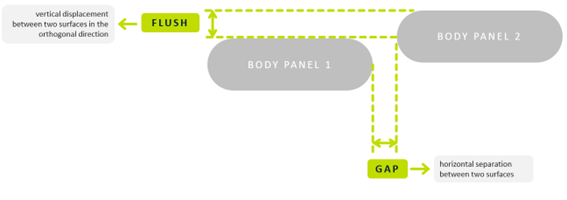
Gap and flush measurement is the process of evaluating the spacing and alignment between adjacent vehicle components, such as doors, fenders, hoods, liftgates, and body panels. In automotive manufacturing, the gap refers to the distance between two parts, while the flush describes how well those surfaces align with each other on the same plane.
Maintaining consistent gap and flush values is essential for achieving high-quality vehicle assembly. Even small deviations can affect the vehicle’s appearance, perceived quality, aerodynamic performance, and overall customer satisfaction. Poor alignment may also contribute to issues such as wind noise, water leaks, vibration, and difficult door or panel operation.
For this reason, automotive manufacturers perform gap and flush measurement throughout the production process, from the Body Shop stage to final assembly. Modern automotive metrology systems use technologies such as stereo vision, 3D imaging, and automated inspection to verify that every vehicle meets OEM dimensional specifications and fit-and-finish requirements.
By ensuring accurate gap and flush alignment, manufacturers can improve product quality, reduce rework, and maintain consistent production standards across all vehicle variants.
Why Measure Gap & Flush from the Body Shop Stage?
The fit and finish of a vehicle begins in the Body Shop, making this one of the most important stages for performing accurate gap and flush measurement. Detecting dimensional deviations early allows manufacturers to correct assembly issues before they progress through subsequent production stages, where adjustments become more complex and costly.
Accurate gap and flush measurements at the Body Shop stage help ensure that doors, hoods, liftgates, fenders, and other body panels are correctly positioned according to engineering specifications. This early validation reduces the risk of:
- Expensive recalls and warranty claims
- Wind noise and water leaks
- Difficult door or panel closures
- Reduced aerodynamic performance
- Poor perceived vehicle quality
- Increased rework during final assembly
By measuring gap and flush early in the production process, automakers can prevent defects from becoming widespread and maintain tighter control over dimensional quality. The data collected can also be compared with measurements taken during final assembly, helping manufacturers identify process variations, improve production consistency, and ensure every vehicle meets OEM quality standards.
As automotive production becomes increasingly automated, early-stage gap and flush inspection plays a critical role in achieving consistent fit-and-finish quality while reducing manufacturing costs and improving customer satisfaction.
Benefits of Automated Gap and Flush Measurement
Automated gap and flush measurement offers significant advantages over traditional manual inspection methods. By using technologies such as stereo vision, 3D metrology, and automated data analysis, manufacturers can obtain accurate and repeatable measurements across every vehicle produced, regardless of production volume.
One of the main benefits is the early detection of dimensional deviations before they impact downstream assembly processes. This helps reduce rework, minimize production disruptions, and prevent quality issues from reaching the final stages of manufacturing.
Automated systems also eliminate operator variability, ensuring consistent measurement results and improving overall process reliability. In addition, the data collected can be used to monitor production trends, identify recurring issues, and support continuous improvement initiatives across the plant.
By implementing automated gap and flush measurement, automotive manufacturers can improve fit-and-finish quality, enhance customer satisfaction, reduce warranty risks, and ensure compliance with OEM quality standards while maintaining high production efficiency.
Advanced Tools for Accurate Measurement: EINES Solutions
At EINES Vision Systems, we provide advanced gap and flush measurement solutions that help manufacturers ensure precise alignment and dimensional quality using cutting-edge technology. Our tools are designed to meet the demands of modern automotive manufacturing:

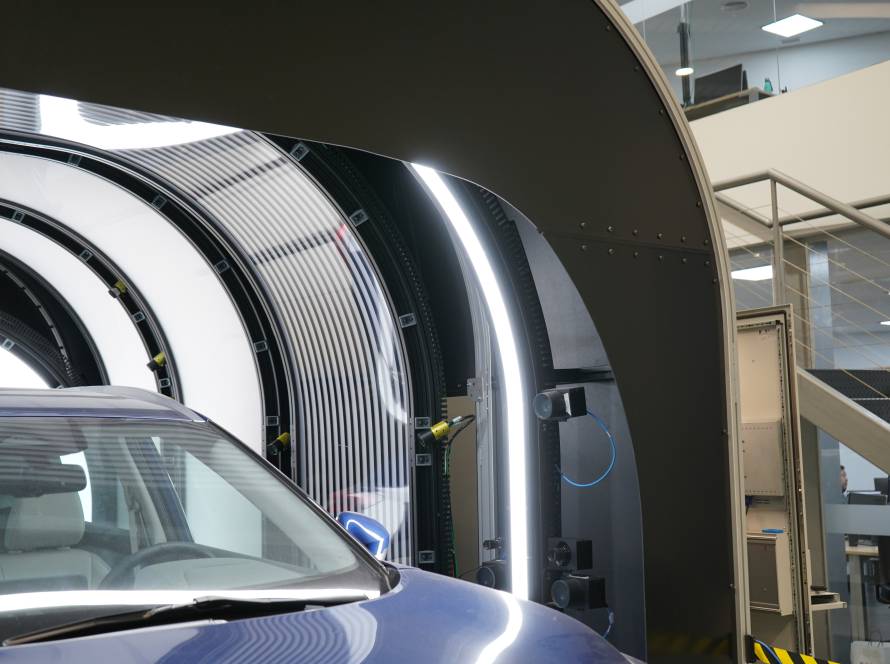
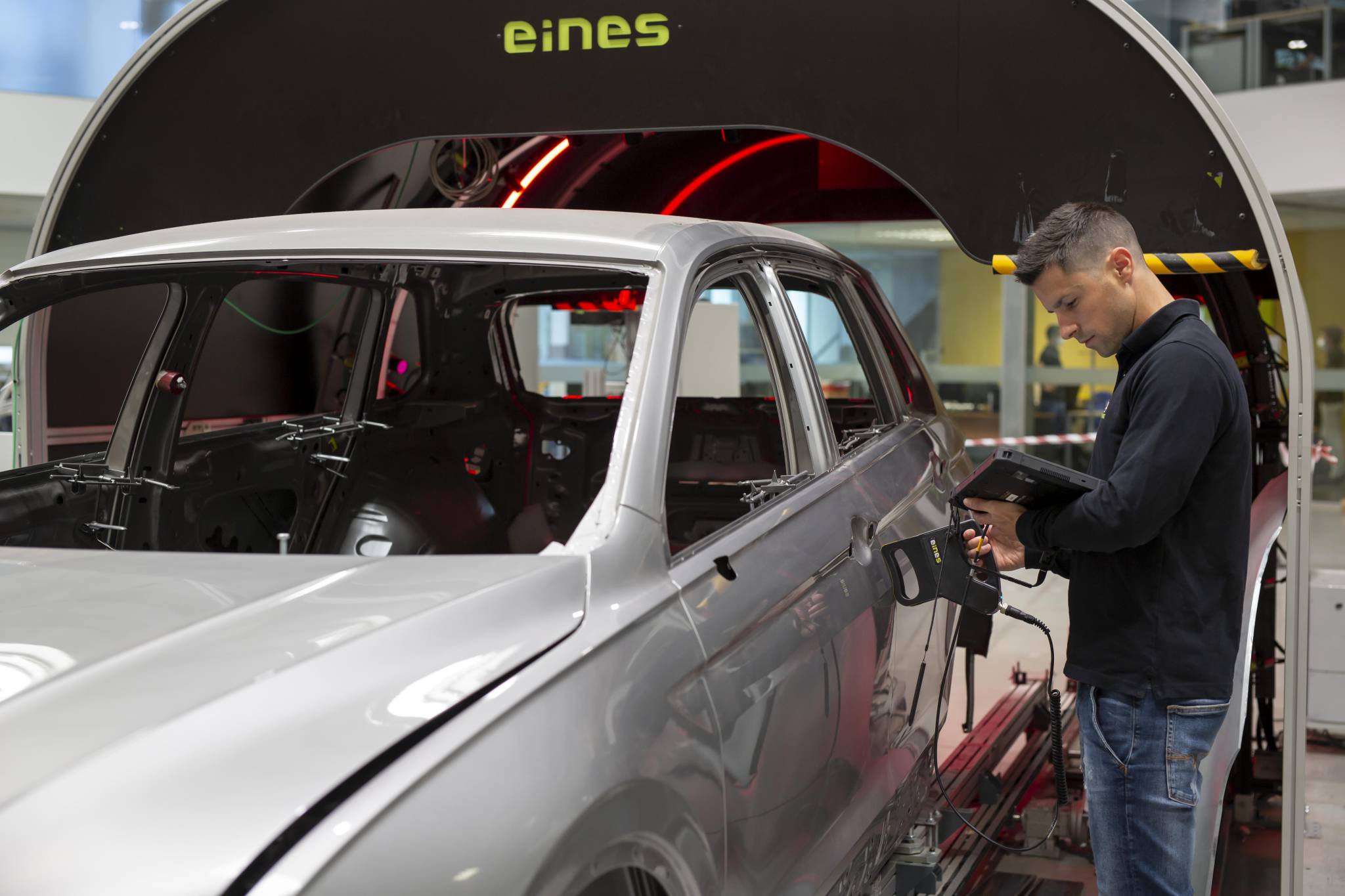
This system uses Stereo Vision Technology, leveraging triangulation between calibrated camera pairs to capture stereo images of the vehicle surface. These stereo images reconstruct 3D data, which is then compared to the vehicle’s 3D CAD model to find the exact measurement section. By correlating this real-world data with the CAD model, EIFIS can measure gap and flush with incredible accuracy. Ensuring alignment meets engineering specifications at every section of the vehicle.

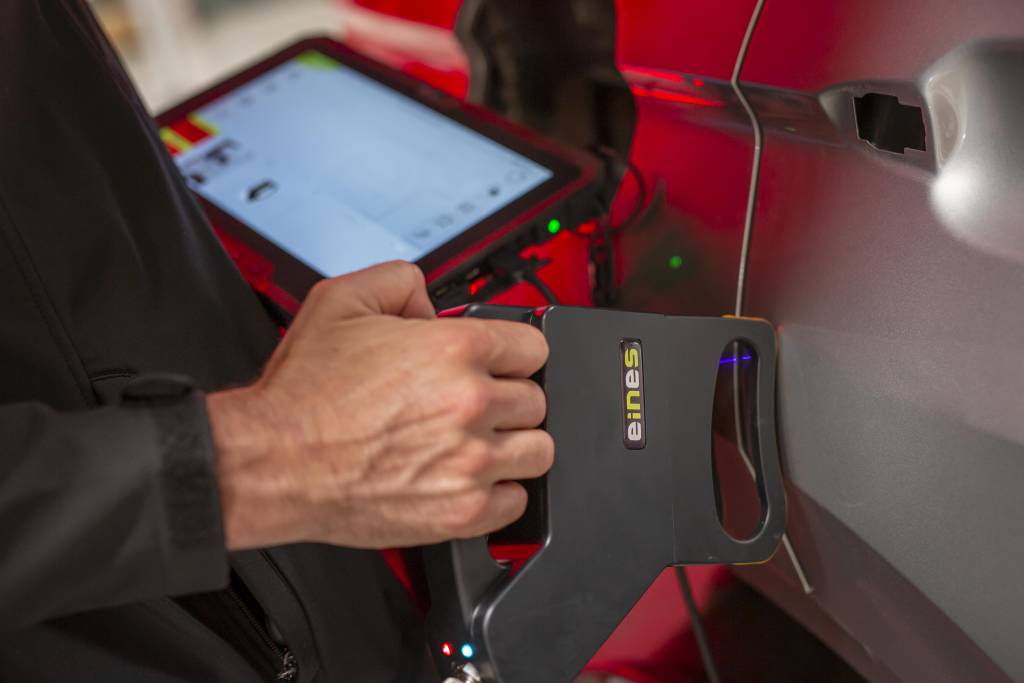
A handheld laser device used for manual measurement in specific areas. This portable tool offers high accuracy for checking critical areas and provides flexibility for on-the-spot inspection.
How Data is used throughout the Assembly Process
Data collected from early gap and flush measurements in the body shop is later compared with measurements taken during the final assembly stage. This ensures that any potential misalignments or changes that occur during the production process are identified and corrected. By continuously monitoring these measurements, manufacturers can analyze data trends, improve processes, and maintain consistent vehicle quality.
By continuously monitoring gap and flush measurement data, manufacturers can track performance trends, detect process variations, and improve assembly consistency across all vehicle models and production batches. This data-driven approach supports continuous improvement initiatives, helps optimize manufacturing processes, and ensures compliance with OEM quality standards.
In addition, historical measurement data provides valuable insights into production stability, enabling quality and engineering teams to identify recurring issues, reduce variability, and maintain consistent fit-and-finish quality throughout the vehicle assembly process.
Improving vehicle quality with Automated Gap and Flush measurement
Measuring gap & flush from the early stages of car production is essential for delivering vehicles that meet high-quality standards. With advanced tools like EIFIS, which uses Stereo Vision Technology for automated 3D analysis, and the EH2 laser handheld device from EINES, manufacturers can ensure accurate, real-time measurements throughout the production process.
These technologies not only help reduce defects but also optimize production efficiency, ensuring vehicles meet engineering specifications and customer expectations.
By implementing these innovative systems, automakers can enhance both product quality and overall production efficiency, ensuring that every vehicle is built to the highest standards.
If you would like to explore how advanced gap and flush measurement technologies can improve your production line, contact the EINES team for more information.
Frequently Asked Questions about Gap and Flush measurement
What is gap and flush measurement?
Gap and flush measurement is the process of verifying the spacing and alignment between adjacent vehicle panels to ensure dimensional accuracy, assembly quality, and consistent fit-and-finish.
Why is gap and flush measurement important in automotive manufacturing?
Accurate gap and flush measurements help manufacturers improve vehicle quality, reduce assembly defects, prevent wind noise and water leaks, and ensure compliance with OEM specifications.
How is the gap and flush measured?
Modern automotive manufacturers use technologies such as stereo vision, 3D metrology, laser measurement devices, and automated inspection systems to capture accurate measurements throughout the production process.
What is stereo vision technology?
Stereo vision technology uses calibrated camera pairs to capture images from different angles and reconstruct a 3D model of the vehicle surface, enabling highly accurate gap and flush measurement.