Automobile headliner technology has become an essential part of innovation in the automotive industry, even if it often goes unnoticed by drivers. While conversations usually focus on electric vehicles, autonomous driving, or next-generation infotainment systems, the headliner quietly plays a major role in shaping comfort, acoustics, and the overall cabin experience.
Most drivers barely notice it, until there’s a problem. A wrinkle in the fabric, poor alignment, or a loose finish can instantly affect the perceived quality of a vehicle interior. On the other hand, a well-designed headliner improves comfort, reduces noise, and gives the cabin a refined, premium feel.
Modern automobile headliners have evolved far beyond simple roof coverings. Today, they combine lightweight materials, acoustic insulation, integrated electronics, and advanced manufacturing processes designed specifically for modern automotive interiors.
What is an automobile headliner?
An automobile headliner, sometimes referred to as a vehicle roof liner, is the material layer attached to the interior roof of a car. While it may appear to be a purely aesthetic component, it serves several critical functions within automotive interiors.
A modern headliner helps:
- Reduce cabin noise and vibration
- Improve thermal insulation
- Enhance passenger comfort
- Create a more premium interior environment
- Integrate lighting, microphones, and sensors
In electric vehicles, where engine noise is significantly reduced, acoustic insulation becomes even more important.
Materials used in modern automobile headliners
Modern headliners typically combine multiple engineered layers, including:
- Polyester fabrics
- Polyurethane foam
- Fiberglass or composite substrates
- Adhesive lamination materials
- Recycled textile fibers
Manufacturers are increasingly focused on lightweight and sustainable solutions, especially in EV production.
Sustainable Automotive Interiors and Lightweight Materials
Reducing vehicle weight is now a strategic priority across the automotive industry. Lightweight headliner materials contribute to:
- Improved fuel efficiency
- Extended EV battery range
- Lower emissions
- Easier assembly integration
This shift is accelerating the development of more sustainable automotive interiors using recycled and low-emission materials.
How automobile headliners are manufactured
Producing a high-quality automobile headliner requires precision manufacturing processes.
Typical production stages include:
- Material layering and lamination
- Thermoforming and shaping
- Precision trimming
- Assembly integration
- Final quality inspection
As manufacturing becomes more connected and automated, these processes are increasingly integrated into Industry 4.0 production environments.
Thermoforming and smart manufacturing
During thermoforming, materials are heated and molded into the roof contour of the vehicle. Small variations in temperature, pressure, or material tension can create visible defects.
That’s why manufacturers increasingly rely on real-time monitoring systems and Industry 4.0 technologies to maintain process consistency.
During thermoforming, materials are heated and molded into the roof contour of the vehicle. Small variations in temperature, pressure, or material tension can create visible defects.
That’s why manufacturers increasingly rely on real-time monitoring systems and Industry 4.0 technologies to maintain process consistency.
Quality control in automobile headliner manufacturing
Quality expectations in automotive interiors are extremely high. Customers immediately notice imperfections on large visible surfaces like the headliner.
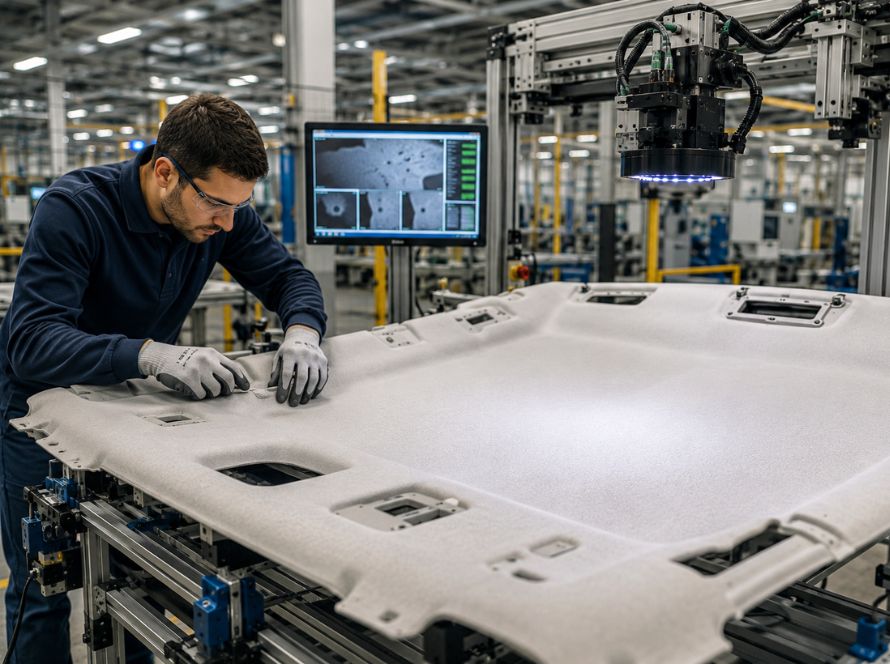
This is where Machine Vision and Artificial Intelligence are transforming quality control.
Modern inspection systems analyze:
- Surface consistency
- Material alignment
- Adhesive distribution
- Texture variations
- Structural deformation

Common defects detected in automobile headliners
Some of the most common include:
- Wrinkles and folds
- Surface waviness
- Poor adhesive bonding
- Color inconsistencies
- Misalignment during assembly
Many of these defects can now be detected automatically using Machine Vision inspection systems.
How Artificial Intelligence and Machine Vision improve inspection
Traditional inspection methods relied heavily on manual checks. Today, Artificial Intelligence enables a much more advanced approach.
AI-powered systems can:
- Detect anomalies in real time
- Analyze texture and pattern consistency
- Learn from historical defect data
- Reduce false positives over time
Combined with Machine Vision, these technologies support predictive quality control and help manufacturers move toward zero-defect manufacturing.
Automobile headliners in electric and autonomous vehicles
Vehicle interiors are evolving rapidly, particularly in EVs and autonomous vehicles.
Modern automobile headliners increasingly integrate:
- Ambient lighting
- Smart sensors
- Microphones
- Acoustic optimization technologies
As automotive interiors become more connected, the headliner is evolving from a passive component into an active part of the cabin experience.
The future of automobile headliner manufacturing
The future of automobile headliners will be shaped by:
- Sustainable materials
- Smart manufacturing systems
- Automated inspection technologies
- AI-driven quality control
As Industry 4.0 continues transforming automotive production, manufacturers are adopting more intelligent, data-driven approaches to maintain consistency and efficiency.
At the same time, Machine Vision and Artificial Intelligence will continue improving surface inspection capabilities, helping automotive manufacturers achieve higher quality standards across next-generation automotive interiors.
How EINES supports automobile headliner inspection and quality control
As inspection requirements become more demanding, manufacturers need technologies capable of maintaining precision at production-line speed.
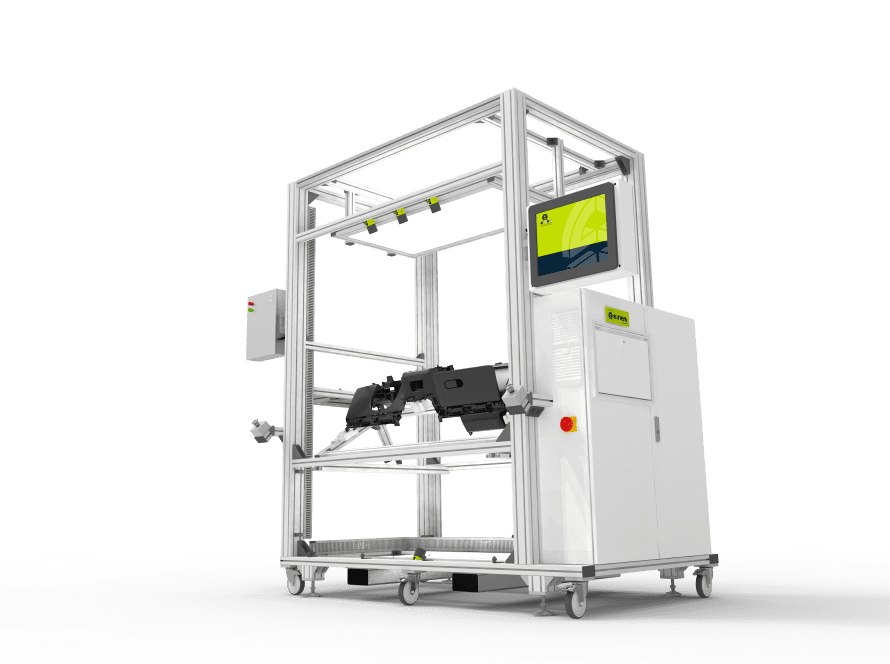
EINES develops advanced Machine Vision systems and automated inspection solutions designed specifically for automotive manufacturing environments.
By combining optical technologies, Artificial Intelligence, and Industry 4.0 integration, EINES helps manufacturers improve inspection accuracy, reduce defects, and optimize quality control processes across modern automotive interiors.
Contact EINES to discover how intelligent inspection solutions can support your automobile headliner manufacturing strategy.