In automotive manufacturing, car paint inspection is no longer just a final quality checkpoint.
It has become a strategic process for:
- protecting brand perception,
- reducing rework,
- and improving paint shop efficiency.
The visible surface of a vehicle communicates precision, durability and excellence before the customer even drives it.
For this reason, digitising inspection processes is essential for manufacturers that want to achieve consistent results across models, colours and production volumes.
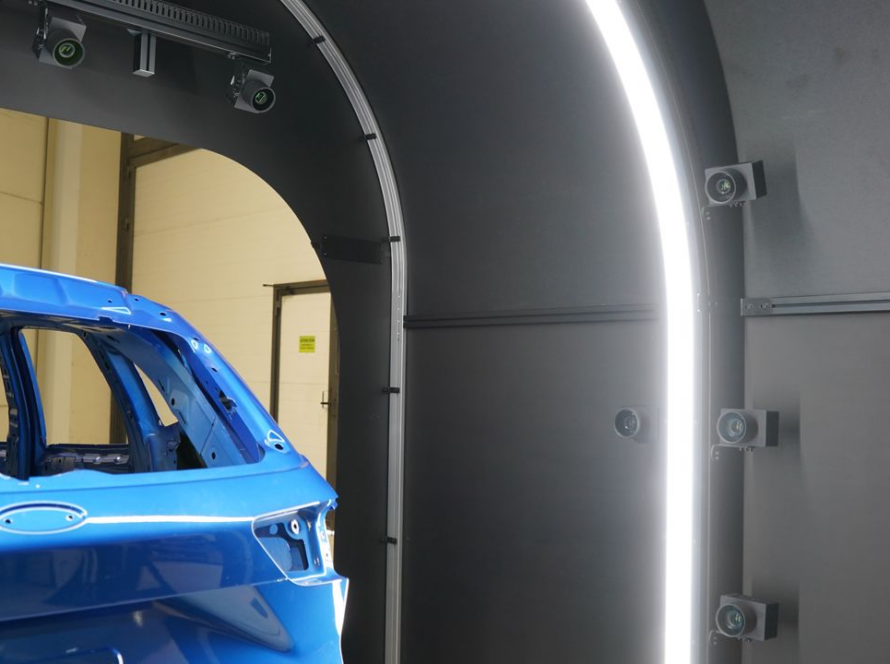
Advanced systems such as EINES’ ESFI (Eines Surface Paint Quality Inspector) bring together LED lighting, high-resolution vision and artificial intelligence to transform automotive paint inspection into a fully automated, objective and data-driven process.
By detecting, locating and classifying paint defects in real time, ESFI enables manufacturers to move from reactive quality control to complete process traceability.
Why is the digitisation of car paint inspection a strategic step towards quality in the automotive sector?
Paint quality is one of the most visible indicators of vehicle quality.
Even small imperfections such as dust, craters, pinholes, scratches, dents, sagging or orange peel can affect the customer’s perception of the vehicle and the manufacturer’s attention to detail.
Digitising paint quality control helps automotive plants:
- standardise inspection criteria,
- reduce subjectivity,
- and generate valuable data for continuous improvement.
Instead of relying only on manual checks, manufacturers can inspect 100% of the surface inline and obtain reliable information about each defect detected.
Surface quality influences the perception of a vehicle’s quality
A flawless painted surface contributes to durability, corrosion protection and long-term customer satisfaction.
From e-coat, primer and clear coat surfaces to the final topcoat, every layer plays a role in the final result.
If defects accumulate during the painting process, they can lead to costly repairs, additional sanding and polishing, higher material consumption and delays at the end of the line.
By installing an automated coating inspection system at critical stages of the paint shop, manufacturers can detect imperfections earlier and prevent them from moving downstream.
Manual inspection limits consistency and traceability
Traditional manual inspection depends heavily on operator experience, fatigue, lighting conditions and subjective criteria.
Even highly trained inspectors may classify the same defect differently or miss small imperfections on complex geometries, edges or feature lines.
Digital inspection systems eliminate this variability.
ESFI applies the same inspection standards 24/7, using artificial intelligence and deep learning models trained with thousands of real paint defect scenarios.
This ensures repeatable paint defect detection across different colours, body types and production conditions.
Continue exploring these topics: Car paint defects: How to detect them before they become a bigger problem
How can car paint inspection be digitised in the paint shop?
Digitising car paint inspection means creating a connected inspection process that:
- captures images,
- detects defects,
- classifies defects,
- maps their exact position,
- and shares the data with quality and repair systems.
EINES’ ESFI tunnel is installed inline, typically after the paint booth or curing oven, and inspects the vehicle while it moves through the line.
High-resolution cameras and LED lighting analyse reflections on the painted surface, capturing thousands of images and generating a complete digital record of the vehicle’s surface condition.
Standardise defect detection and classification criteria
One of the main advantages of automated automotive paint inspection is the ability to standardise quality criteria.
ESFI can classify defects into groups such as dust, bubble, pinhole, crater, scratch, dent, bump, fibre, convex or concave defects.
This classification is powered by deep learning, allowing the system to adapt to complex paint finishes, metallic paints, different vehicle models and multiple colours.
Customisable sensitivity settings also allow each plant to define inspection thresholds according to its quality standards, model mix and customer requirements.
Record the type of defect, its severity and its exact location in real time
Effective inline paint inspection must do more than simply detect a defect. It must provide actionable information.
ESFI generates real-time 3D defect mapping, including defect type, contour, size, severity and exact location on the vehicle body or painted component.
This information can be used:
- by operators for guided manual repair,
- by robotic systems for automatic sanding, cleaning and polishing.
When inspection data is synchronised with automatic repair solutions, each defect can be assigned to the most suitable process based on its location, characteristics and severity.
Centralise inspection data and link it to quality systems
Digital inspection becomes truly powerful when data is centralised.
ESFI integrates with MES and Quality Management Systems, allowing inspection results to be stored, visualised and analysed in dashboards and reports.
Each inspected vehicle or part receives a complete quality record, including defect maps, classification data and process information. This creates full traceability across the paint shop and supports better decision-making for quality, production and maintenance teams.
Don’t miss our article on: 10 Key Benefits of the ESFI System for Automotive Surface Inspection and Paint Quality Control
How does full traceability improve paint quality control and reduce rework?
Full traceability connects every inspection result with the vehicle, part, model, colour, paint booth, shift and process conditions.
This gives manufacturers a clear view of what happened, where it happened and how often it occurs.
Instead of treating each defect as an isolated issue, teams can:
- identify patterns,
- compare results between shifts or lines,
- and detect process deviations
All of this before they become larger quality problems.
Detect recurring defect patterns more quickly
By storing inspection data in a secure database, ESFI enables statistical analysis and trend monitoring over time. If a specific defect starts appearing more frequently on a certain model, colour or area of the body, the system helps quality teams detect it quickly.
This data-driven approach improves responsiveness and avoids repeated manual checks. It also supports predictive and preventive analysis, helping plants act before defects generate scrap, rework or customer complaints.
Enable root cause analysis and corrective actions
Quality teams can investigate whether an issue is related to:
- application parameters,
- booth conditions,
- contamination,
- equipment performance,
- substrate characteristics,
- or curing conditions.
The result is faster and more accurate corrective action.
Instead of relying on assumptions, manufacturers can use objective data to adjust process parameters, optimise equipment and improve paint application consistency.
Improve overall paint quality (FTQ), reduce rework and optimise paint shop performance
A digitised car paint inspection process directly supports First-Time Quality.
When defects are detected early and accurately, only vehicles that meet the required standard move forward. This reduces end-of-line rework, paint waste, energy consumption and manual labour.
It also improves sustainability. Less rework means fewer consumables, lower CO₂ emissions and more efficient use of resources. For OEMs and Tier One Suppliers, these improvements contribute to ESG goals.
EINES’ ESFI system is designed to adapt to different plant layouts, production flows, vehicle models and paint colours.
Its modular architecture allows integration into existing paint shops without major disruption, while its AI-based technology supports continuous improvement through real-time data, reporting and full traceability.
Digitising automotive paint inspection is a strategic step towards:
- higher quality,
- greater efficiency,
- and smarter paint shop management.
With automated paint quality control, manufacturers can achieve more consistent finishes, reduce costs and build a reliable digital foundation for the paint shop of the future.
Do you want to digitize your car paint inspection process and achieve full traceability in your paint shop?
At EINES, we help automotive manufacturers and Tier One Suppliers transform surface quality control with AI-based inspection systems such as ESFI, designed to detect, classify and map paint defects in real time. Contact our team to discover how our solutions can help you improve paint quality, reduce rework and optimize paint shop efficiency.