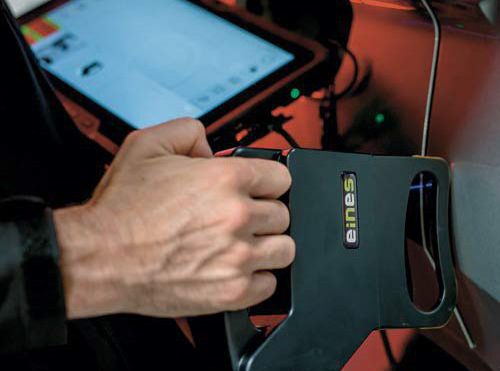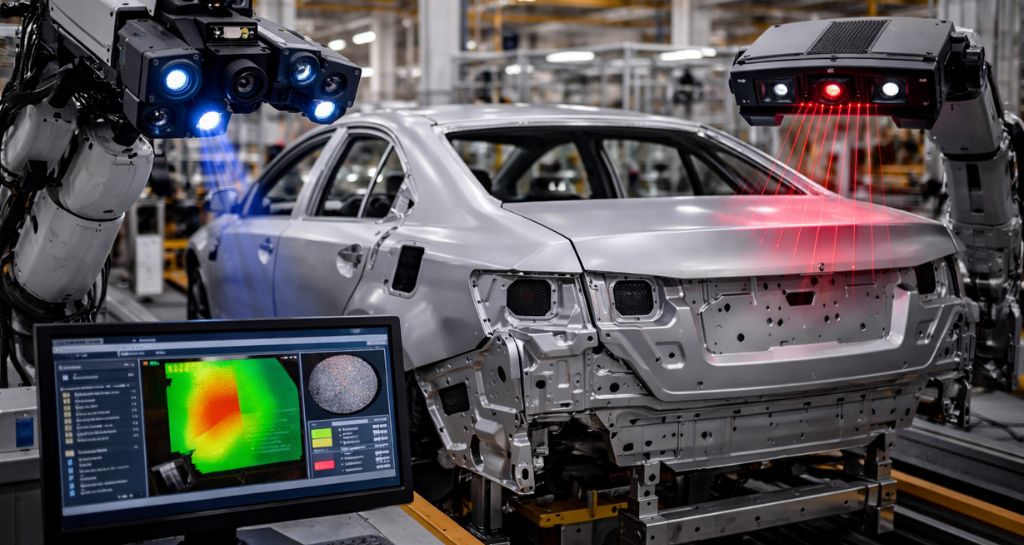
Vision systems have become a cornerstone of advanced automotive quality control. As vehicle designs grow more complex and customer expectations for flawless finishes and perfect alignment increase, manufacturers rely on industrial vision systems to guarantee consistency, precision, and efficiency across every production stage.
From body-in-white measurement to paint inspection and final assembly verification, these systems operate continuously inside high-speed manufacturing environments. Leading global OEMs such as Toyota Motor Corporation integrate advanced vision systems into their production lines to maintain strict dimensional tolerances and ensure consistent visual quality across all vehicle models. These manufacturers rely on highly automated inspection technologies to support zero-defect strategies and meet the increasing expectations of global markets.
As a result, machine vision inspection systems are no longer optional tools. They are strategic assets that protect brand reputation and support zero-defect manufacturing strategies.
What are Vision Systems in automotive manufacturing?
Vision systems are integrated hardware and software platforms designed to inspect, measure, and verify products during manufacturing. In automotive environments, they combine structured lighting, and high-resolution cameras to capture detailed surface and dimensional data in real time.
A typical industrial vision system includes:
- Industrial-grade cameras
- Structured or diffuse lighting systems
- Image processing software
- Calibration and alignment modules
- Data reporting interfaces
Unlike manual inspection methods, automated vision systems provide:
- Non-contact de
- Real-time defect detection
- High inspection repeatability
- Inline quality verification
This combination ensures consistency at production speeds that would be impossible to maintain through human inspection alone.
Why Are Vision Systems Critical for Automotive Quality Control?
One of the most searched long-tail questions in manufacturing is:
Why are vision systems important in automotive manufacturing?
Automotive production requires extremely tight tolerances. Even minor deviations in panel alignment, weld positioning, or surface finish can result in visible defects or costly rework.
Vision systems enable manufacturers to:
- Maintain dimensional accuracy across vehicle platforms
- Detect micro surface defects before vehicles leave the line
- Perform precise gap and flush measurement
- Verify assembly positioning in real time
- Ensure traceability and compliance with OEM standards
Without these technologies, maintaining global production uniformity across multiple plants would be highly challenging.
Types of Vision Systems used in Automotive Plants
Different inspection needs require specialized vision technologies. Below are the primary types deployed in automotive production environments.
2D Vision Systems for surface inspection
2D vision systems are commonly used for contrast-based inspections and presence verification.
Typical applications include:
- Label and barcode inspection
- Component presence detection
- Surface blemish identification
- Paint surface uniformity checks
These systems analyze pixel contrast and edge detection to identify irregularities. While highly effective for surface-level inspection, they do not provide depth information.
3D Vision Systems for High-Precision Measurement
When dimensional control is critical, 3D vision systems are required. These technologies provide depth data and surface topology analysis.
Common 3D inspection technologies include:
- Structured light projection
- Laser triangulation
- Stereo camera systems
Typical automotive applications:
- Body alignment control
- Gap & flush measurement
- Structural geometry validation
- Weld seam verification
By enabling non-contact dimensional measurement, 3D vision systems eliminate the need for manual gauges and reduce measurement variability.
Inline vs. Offline Vision Inspection Systems
Another frequently searched question is:
What is the difference between inline and offline vision systems?
Inline inspection systems:
- Integrated directly into production lines
- Operate at full manufacturing speed
- Provide immediate feedback
- Support continuous monitoring
Offline inspection systems:
- Located in metrology laboratories
- Offer ultra-high precision
- Used for batch validation
- Support calibration verification
Both systems complement each other within a comprehensive automotive quality control strategy.
Key Applications of Vision Systems across the automotive production line
Vision systems are deployed at multiple stages of vehicle manufacturing.
Body-in-White Inspection
In early production phases, structural integrity is verified.
Applications include:
- Body-in-white measurement
- Automated weld inspection
- Structural alignment analysis
Detecting dimensional deviations early prevents downstream assembly issues and costly rework.
Paint Shop Surface Inspection
Painted surfaces are among the most challenging inspection targets due to their reflectivity.
Vision systems detect:
- Orange peel texture
- Dust inclusions
- Runs and sags
- Gloss inconsistencies
Using multi-angle lighting configurations and reflectivity analysis, automated systems ensure premium surface quality.
Final Assembly Verification
During final assembly, precision remains essential.
Vision systems verify:
- Door and panel alignment
- Trim positioning
- Steering wheel alignment
- Exterior component placement
These inspections ensure vehicles meet strict dimensional and aesthetic requirements before shipment.
How Accurate Are Vision Systems in Automotive Manufacturing?
A common Google-related question is:
How accurate are industrial vision systems?
Modern high-precision vision systems can detect sub-millimeter deviations depending on system configuration and calibration.
Accuracy depends on:
- Camera resolution
- Optical lens quality
- Lighting stability
- Environmental control
- Calibration frequency
With proper setup, advanced systems deliver exceptional repeatability, ensuring consistent inspection results across shifts and production cycles.
Benefits of implementing Vision Systems in automotive plants
Deploying vision systems generates measurable operational improvements.
Operational Benefits
- Higher inspection repeatability
- Reduced human error
- Improved production throughput
- Enhanced process traceability
- Lower scrap and rework rates
Financial Advantages
- Reduced warranty claims
- Lower labor costs
- Faster defect identification
- Improved first-pass yield
Strategic Benefits
- Stronger brand reputation
- Global production consistency
- Standardized quality control procedures
- Scalability across multiple facilities
These benefits explain why vision systems are integral to modern automotive manufacturing strategies.
Technical challenges in Automotive Vision System implementation
Despite their advantages, vision systems must overcome specific challenges in industrial environments.
Lighting Optimization
Metallic and painted surfaces reflect light unpredictably. Advanced lighting setups are required to minimize glare and false detections.
High-Speed Production Constraints
Inspection must occur without slowing production lines. Systems must capture and process images within milliseconds.
Environmental Factors
Temperature changes, vibration, and airborne particles can affect measurement accuracy.
Integration with Automation Infrastructure
Vision platforms must synchronize with:
- Robotic systems
- Conveyor lines
- Manufacturing Execution Systems (MES)
- Data reporting platforms
Proper integration ensures long-term stability and performance.
How to select the Right Vision System for Automotive Quality Control
Manufacturers frequently ask:
How do you choose the best vision system for automotive manufacturing?
A structured evaluation includes:
- Defining inspection objectives
- Determining required measurement precision
- Evaluating compatibility with production speed
- Assessing environmental conditions
- Ensuring integration with existing automation systems
Choosing the correct configuration ensures long-term efficiency and reliability.
Vision Systems and the evolution of Smart Automotive Manufacturing
As automotive plants evolve into interconnected production environments, vision systems play a central role in enabling:
- Real-time production monitoring
- Data traceability across assembly stages
- Automated quality documentation
- Continuous process optimization
By integrating vision systems for automotive quality control into manufacturing ecosystems, companies strengthen dimensional precision, protect surface quality, and maintain global competitiveness in increasingly demanding markets.
To fully leverage the potential of vision systems in automotive quality control, it is essential to partner with technology providers that combine deep industry expertise with advanced inspection capabilities. At EINES Vision Systems, we develop cutting-edge solutions tailored to the specific challenges of modern automotive manufacturing, helping OEMs and suppliers achieve zero-defect production and operational excellence. If you want to explore how our vision technologies can enhance your production processes, get in touch with our team.